Medieval Murcia
A Frontier Land Between Empires, Faiths and Kingdoms
The Middle Ages were a decisive period in the history of the Region of Murcia, marked by political instability, cultural coexistence and its role as a strategic frontier territory. From the decline of Roman authority to the consolidation of the Kingdom of Murcia within the Crown of Castile, the region experienced successive phases of Visigothic, Byzantine, Islamic and Christian rule. This complex past left behind a dense network of fortresses, cities, irrigation systems and religious buildings that still shape the Murcian landscape today.


Moratalla Castle, built mostly by the Order of Santiago in the 15th century on top of an earlier Islamic-era castle (9th century). Photo from Wikimedia.
Visigoths and Byzantines:
From Roman Decline to a Fortified Interior
Following the weakening of Roman power, the region suffered instability and external attacks. In 425 AD, Carthago Nova was sacked by the Vandals, and later became the scene of conflict between Roman and Vandal forces, which resulted in a defeat for the Romans in the so-called Battle of Cartagena (461).
After the fall of the Western Roman Empire, Murcia became part of the Visigothic Kingdom of Hispania. Urban life declined in many areas, but some cities retained political and religious importance. One of the most significant sites from this period is Begastri, which became an episcopal seat and a regional administrative centre. Archaeological remains include churches, walls and funerary structures, illustrating continuity between Roman and early medieval traditions.
During the 6th century, the Byzantine Empire reconquered much of the southeastern Iberian coast, creating the province of Spania with capital in Cartago Spartaria (Cartagena). However, by the early 7th century, the Visigoths reconquered the territory, restoring political unity. After reconquering this territory, the Visigoths reinforced inland strongholds, prompting the consolidation of fortified cities such as Begastri and Eliocroca (Lorca). In 621, King Suintila recaptured Cartagena, ending Byzantine presence. Thereafter, Murcia became a relatively stable Visigothic military frontier, with Lorca acting as a key defensive centre.
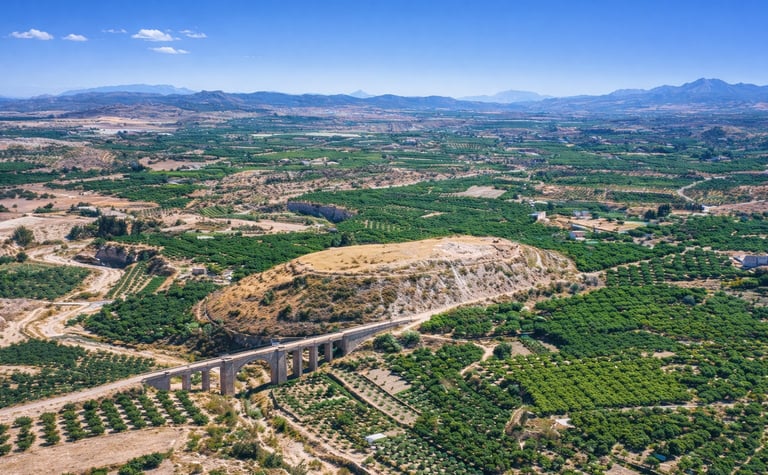
On the outskirts of present-day Cehegín is located "Cabezo de Roenas", a hill on which the Roman city of Begastri was established, which lasted into Visigothic times, even having its own bishop.
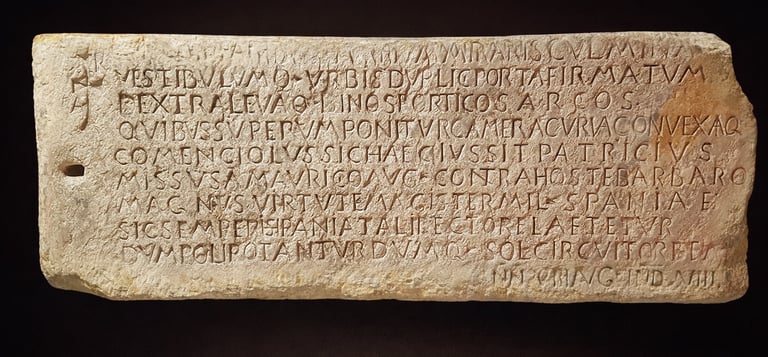
The Inscription of Comenciolo, made around 589, is considered the most important epigraphic evidence of the Byzantine presence in Hispania. It describes the construction / restoration of the city walls. Archaeological Museum of Cartagena.
The Cora of Tudmir and
the Islamic Conquest
In 713, Muslim forces entered the region and reached an agreement with the Visigothic leader Theodemir (Tudmir) through the Pact of Tudmir. This treaty allowed the territory, known as the Cora of Tudmir, to retain a degree of autonomy in exchange for tribute and loyalty, enabling a relatively peaceful transition to Islamic rule.
During the early Islamic period, the region retained many existing settlements until internal conflicts during the Emirate of Córdoba led to administrative reorganisation. In 825, Emir ʿAbd al-Raḥmān II ordered the foundation of Murcia as a new capital, strengthening central authority. The city was carefully planned and connected to an advanced irrigation network that transformed the Segura valley into the fertile Huerta of Murcia.
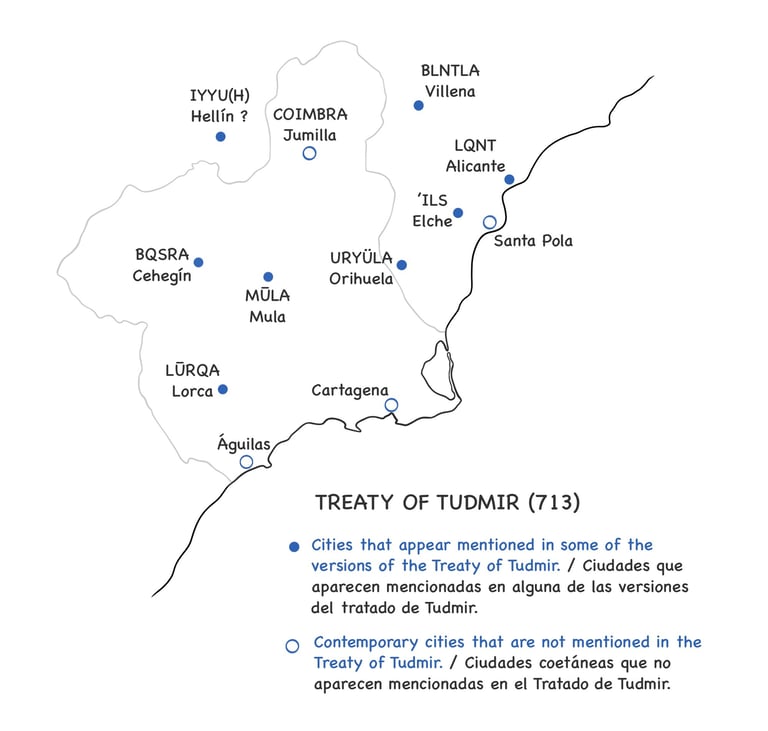
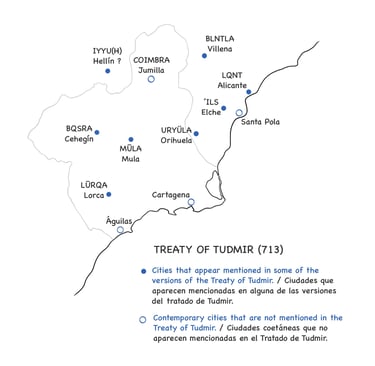
The cities of the Treaty of Tudmir according to: J.B. Vilar: History of the City and Bishopric of Orihuela. Murcia. 1976.
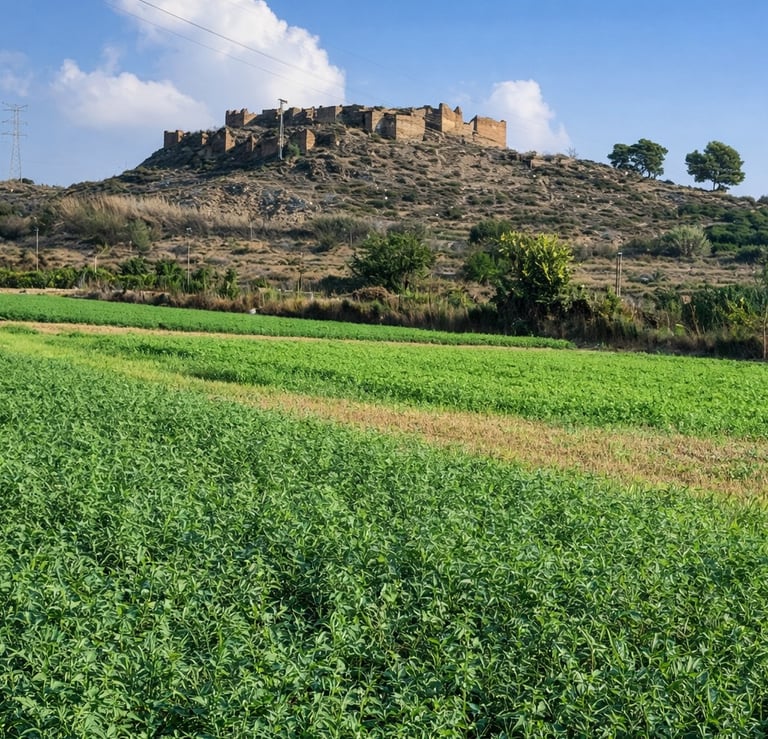
About 5 km from the city of Murcia, in Monteagudo, is the Alcázar of Ibn Sad, ordered to be built by Ibn Mardanish in the 12th century.
Murcia in Al-Ándalus: Taifas, the Wolf King and Almohads
During the Caliphate of Córdoba (929–1031), Murcia prospered as an administrative and economic centre. After the caliphate’s collapse, the region passed through successive taifa kingdoms, including brief independent states centred on Murcia and Lorca.
The period of greatest splendour came under Ibn Mardanish, known as the Wolf King (1147–1172). Ruling from Murcia and Lorca, he resisted Almohad expansion while maintaining alliances with Castile and Aragon. His reign brought economic growth, monumental construction and military strengthening; his gold coinage (morabetino lupino) circulated widely across Europe.
After his death, the Almohads conquered Murcia in 1172. Their rule was short-lived: following the defeat at Las Navas de Tolosa (1212), Almohad power collapsed, leading to the uprising of Ibn Hud in 1228, who briefly restored Murcian political centrality before the advance of Christian kingdoms.
Christian Conquest and the Kingdom of Murcia
In 1243, the emir of Murcia signed the Pact of Alcaraz, placing the territory under Castilian protection. While many cities accepted the agreement, others such as Mula and Cartagena resisted and were conquered militarily in 1244–1245 by the infante Alfonso, future Alfonso X.
Tensions led to a major Mudéjar revolt in 1264, which was suppressed in 1266 with the help of James I of Aragon. This ended the protectorate and marked the definitive establishment of the Kingdom of Murcia as a Castilian territory.
Between 1296 and 1305, Murcia was briefly occupied by James II of Aragon, before returning to Castile under the Treaties of Torrellas and Elche. For centuries, Murcia remained a triple frontier between Castile, Aragon and the Nasrid Kingdom of Granada, suffering wars, raids and population loss until the conquest of Granada in 1492.
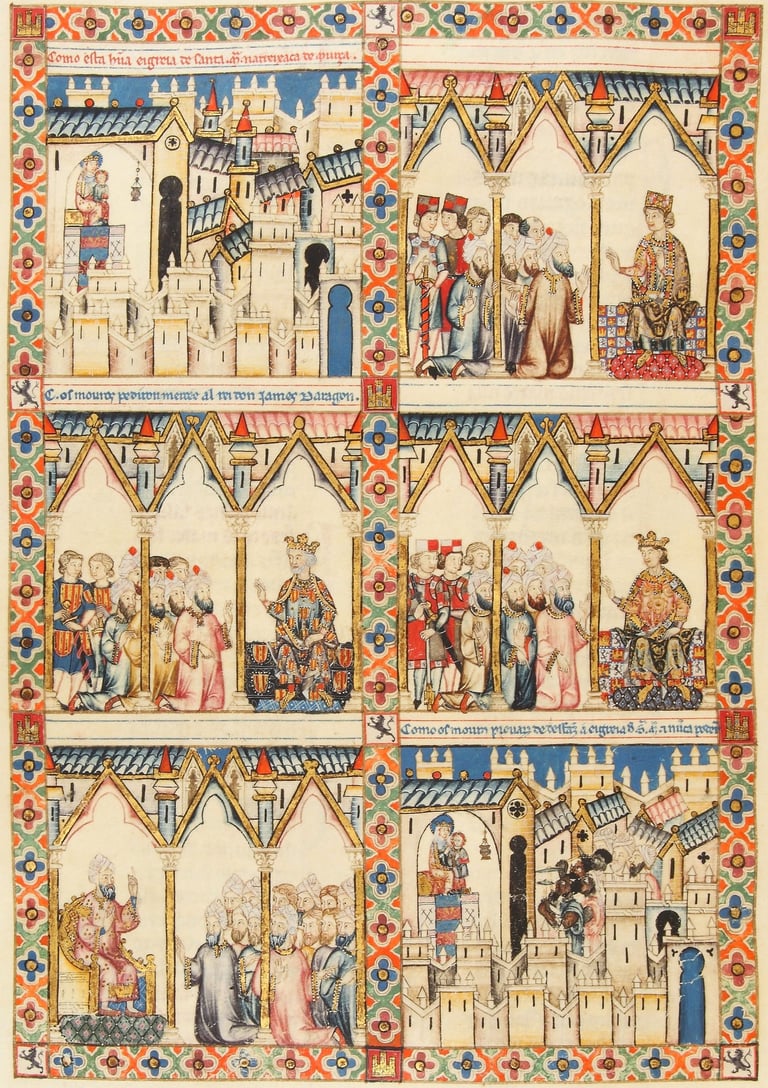
The "Cantigas de Santa María," composed during the reign of Alfonso X, includes a story about an image of the Virgin Mary venerated in a suburb of the city of Murcia (Arrixaca). The Cantiga features a representation of the city and of Kings James II of Aragon and Alfonso X of Castile. RBME Patrimonio Nacional.
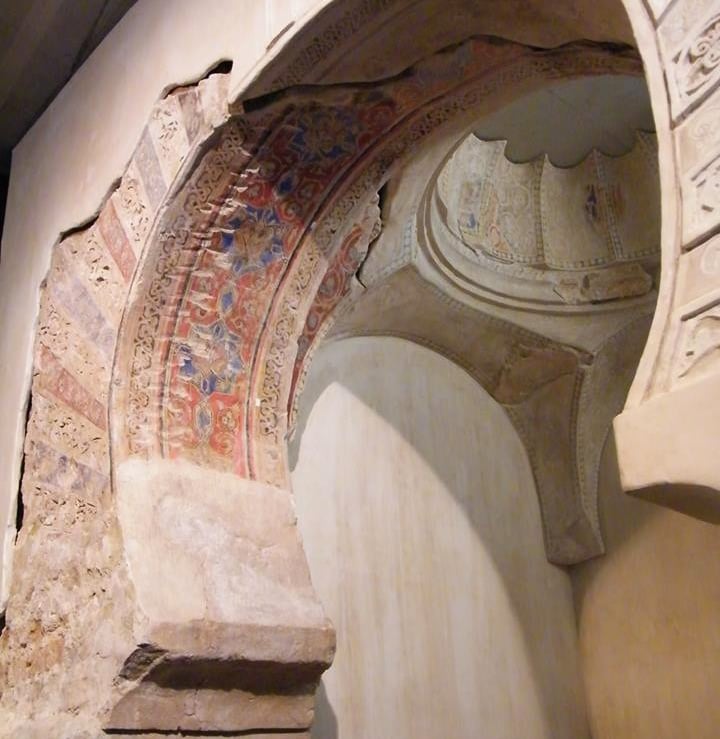
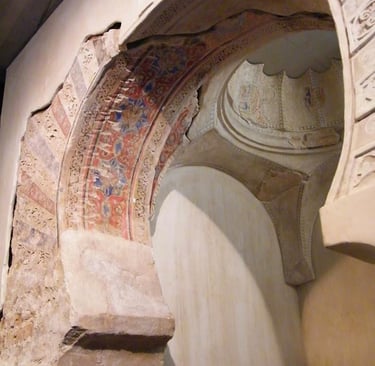
Detail of the Muslim oratory that was located in the Alcázar Mayor of Murcia during the time of King Ibn Mardanish. Church/Museum of San Juan de Dios, Murcia. Photo by Gregorico.
Muslims, Christians and Jews in Medieval Murcia
Coexistence, Conflict and Cultural Legacy
Medieval Murcia was a land where three religious and cultural communities — Muslims, Christians and Jews — coexisted over several centuries, especially between the Islamic period and the consolidation of Christian rule. This coexistence was not always peaceful, but it created a complex social fabric whose legacy remains visible in the region’s urban layout, agriculture, architecture and cultural traditions.
Under Islamic rule, Muslims formed the majority of the population and shaped the foundations of medieval Murcian society. They developed cities, irrigation systems and agricultural landscapes, particularly in the Segura valley and the Huerta of Murcia, introducing crops, technologies and urban models that would endure long after the end of Al-Ándalus.
After the Christian conquest in the 13th century, Muslims who remained became Mudéjars, allowed initially to preserve their religion, language and customs under Castilian sovereignty. Over time, restrictions increased, leading to revolts, forced conversions and, eventually, the emergence of the Morisco community, whose presence would continue to shape rural life until their expulsion in the early 17th century.
Jewish communities also played a significant role in medieval Murcia, particularly in urban centres such as Murcia, Lorca and Cartagena. Jews were often involved in trade, crafts, medicine and administration, living in designated quarters (juderías) while contributing actively to economic and cultural life. Their presence ended abruptly with the expulsion of the Jews from Castile in 1492.
The legacy of this multicultural medieval society can still be traced in place names, irrigation networks, defensive architecture, urban layouts and local traditions. Medieval Murcia stands as a powerful example of how cultural interaction — marked by cooperation, conflict and adaptation — shaped a frontier society whose identity was forged through diversity.


Archaeological remains of the medieval synagogue of Lorca, restored for public visits. Photo courtesy of Paradores.
Medieval Architecture: Castles, Churches and Frontier Landscapes
Medieval architecture in Murcia is predominantly military, reflecting its frontier condition. Castles such as Aledo, Caravaca, Bullas, Moratalla, Ricote, the Castle of Lorca, and the tower-fortress of Alguazas dominate the landscape. Built mainly using rammed earth (tapial) and simple masonry, these fortifications created a distinctive defensive skyline.
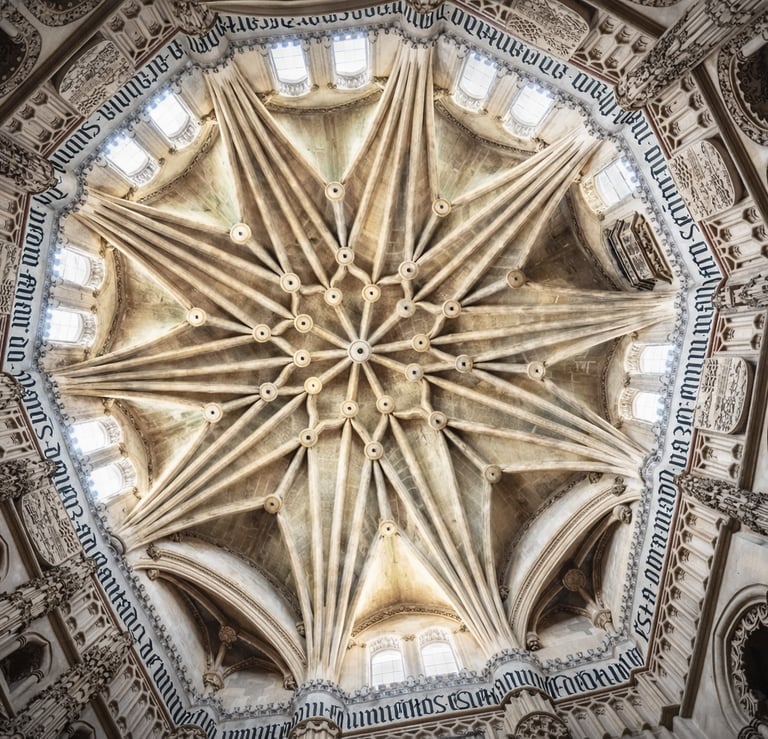
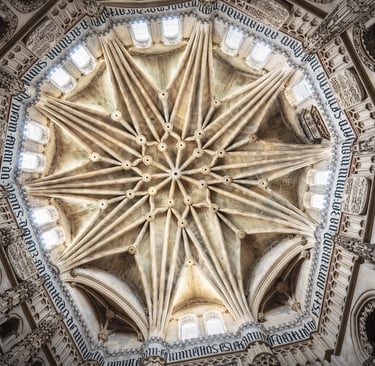
Religious architecture developed after the Christian conquest. Notable Gothic buildings include the Old Cathedral of Cartagena (Santa María la Vieja), parish churches in Lorca, the Church of Santiago in Jumilla, the Monastery of Santa Clara la Real in Murcia, and late Gothic elements in the Cathedral of Murcia, such as the spectacular Chapel of the Vélez. Most of these buildings reflect a gradual transition from medieval Gothic to Renaissance forms.